Women in Orange BG

Gen_We: A Regenerative Tourism System for Marine Protection

UX Design, Leadership, AI

_

© 2026 (work in progress)

Nanda Dias | Staff Designer

© 2026

Nanda Dias | Staff Designer

Most of us would help the ocean if we knew how. I started working to close that gap.

Most of us would help the ocean if we knew how. I started working to close that gap.

Two problems sit behind this project: an ocean that will miss its 30x30 goal without far more people acting, and people who already feel cut off from nature and short on purpose. A solo project from a d.MBA cohort, still running as a personal lab alongside my day job. I built the business case, the behavioural model and the funding structure myself.
The Challenge

Less than 3% of the ocean is highly protected. That same ocean produces more than half the oxygen we breathe.

The global 30x30 goal is to protect 30% of it by 2030. Marine protection currently receives around USD 1.2 billion a year. It needs 15.8 billion.

A gap of USD 14.6 billion a year. Money is not the only thing missing.

There is a second gap running alongside it. A lot of people want to do something real about the state of the ocean and have nowhere useful to put that intent.

Gen_We is a regenerative tourism concept built to close both gaps at once. It connects individual travellers to marine restoration work that is already happening, and turns their trip into funding and labour for the NGOs.

My Role & Strategic Approach

Exploring new AI tools let me move faster through roughly 50 sources across economics, behavioural science, marine policy and business strategy. From that, I made five decisions that define the concept.

1. Design for restoration. Grounded in Kate Raworth’s Doughnut Economics, so success is measured against a social floor and a planetary ceiling.

2. Attack the intention-action gap directly. Stephen Wendel’s CREATE funnel showed me where good intentions actually die. I used his “Cheat” strategy: shift the logistical burden off the traveller and the NGO, and put it on the product.

3. Fund it with blended finance. Grants and concessional capital de-risk the early stage so private investment can follow. Higher-tier contributors fund Impact Scholarships, so the community is not limited to people who can afford to travel.

4. Choose depth and trust over mass-market scale. For this first stage, I am choosing depth over speed. Curation protects the integrity of the conservation work, and it also keeps travellers safe: every partner is checked before someone is sent to support a project in an unfamiliar place.

5. Confirm the market was real before committing. Top-down sizing from Dataintelo and Grand View Research puts regenerative tourism at USD 185.2 billion in 2024, growing at 12.4% CAGR. That matters because a conservation product that only works on goodwill does not survive its first funding winter.

The Challenge

Less than 3% of the ocean is highly protected. That same ocean produces more than half the oxygen we breathe.

The global 30x30 goal is to protect 30% of it by 2030. Marine protection currently receives around USD 1.2 billion a year. It needs 15.8 billion.

A gap of USD 14.6 billion a year. Money is not the only thing missing.

There is a second gap running alongside it. A lot of people want to do something real about the state of the ocean and have nowhere useful to put that intent.

Gen_We is a regenerative tourism concept built to close both gaps at once. It connects individual travellers to marine restoration work that is already happening, and turns their trip into funding and labour for the NGOs.

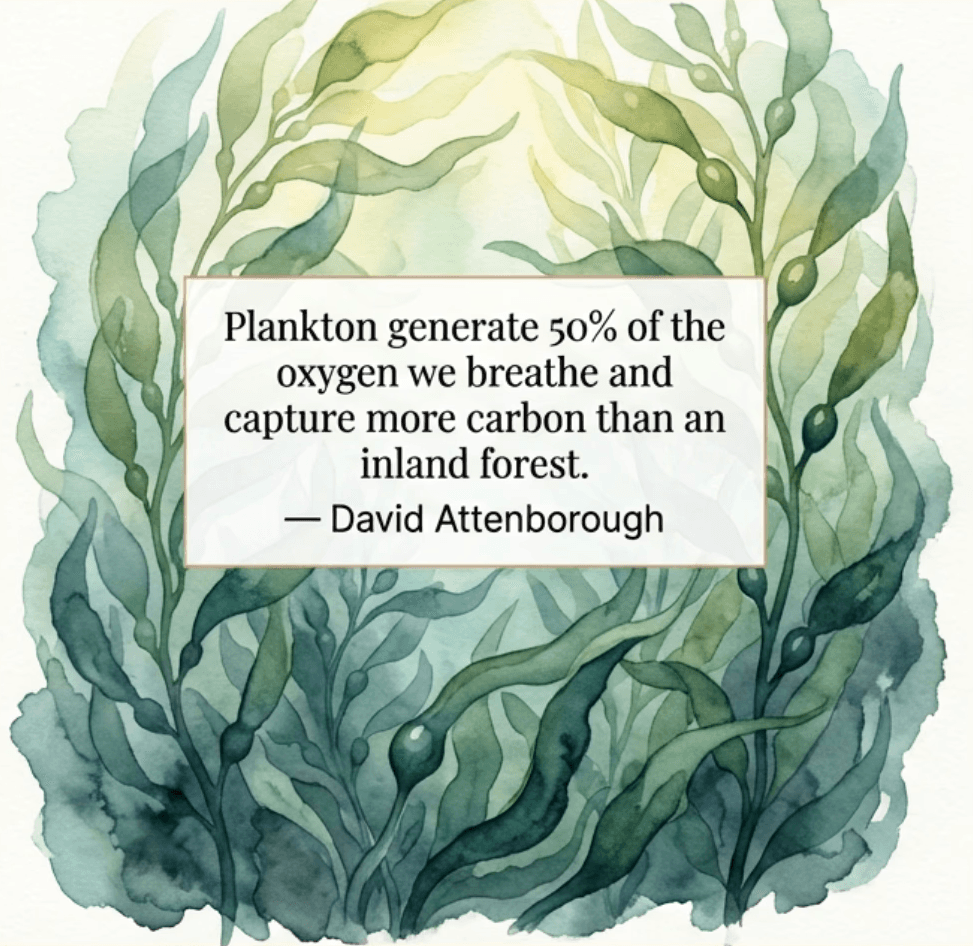
plankton image
plankton image

My Role & Strategic Approach

Exploring new AI tools let me move faster through roughly 50 sources across economics, behavioural science, marine policy and business strategy. From that, I made five decisions that define the concept.

1. Design for restoration. Grounded in Kate Raworth’s Doughnut Economics, so success is measured against a social floor and a planetary ceiling.

2. Attack the intention-action gap directly. Stephen Wendel’s CREATE funnel showed me where good intentions actually die. I used his “Cheat” strategy: shift the logistical burden off the traveller and the NGO, and put it on the product.

3. Fund it with blended finance. Grants and concessional capital de-risk the early stage so private investment can follow. Higher-tier contributors fund Impact Scholarships, so the community is not limited to people who can afford to travel.

4. Choose depth and trust over mass-market scale. For this first stage, I am choosing depth over speed. Curation protects the integrity of the conservation work, and it also keeps travellers safe: every partner is checked before someone is sent to support a project in an unfamiliar place.

5. Confirm the market was real before committing. Top-down sizing from Dataintelo and Grand View Research puts regenerative tourism at USD 185.2 billion in 2024, growing at 12.4% CAGR. That matters because a conservation product that only works on goodwill does not survive its first funding winter.

plankton image
Men Red BG

Here's the brief version, if a podcast suits your day better than reading.

Scaling Marine Conservation With Startup Logic
Men Red BG
Men Red BG

How this began

For three years I was a Product Design Lead at SAP, building carbon-calculation and ESG goal-management systems for large companies. That work also made me think about individuals who wanted to feel closer to causes tied to ocean and climate action, with not many ways to do that. David Attenborough's Ocean documentary deeply inspired me to start this side project.

The Tension I Am Not Resolving

I used generative AI, Obsidian and NotebookLM, to synthesise the research and produce the concept podcast and pitch materials. Without it this project would have taken five times longer, and I had no budget to hire collaborators at this stage. Every output was curated and rewritten by me, roughly ten passes each.

Think of it as a race. A skateboard and an electric car can both cross the same finish line, one just takes far longer. That is how I see AI: it moves the work faster. What it cannot replace is the exchange between people who care about the same problem.

This played out in practice: peers adding an anecdote or an angle I would never have reached made the learning stick in a way no tool did.

Beyond research, I used agentic AI tools to build a working piece of the product itself: the Field Journal, an in-app wellbeing companion where travellers log how they feel before, during and after a trip, paired with an AI companion that responds to their own ratings. Built across Next.js, Supabase and Vercel, with Playwright testing and an accessible Material Design 3 / WCAG 2.2 system. This is the first working version. Voice and photo logging are planned for future versions.

Want to dive into the details?

Men Red BG
Men Red BG

Questions people usually ask

Expand all

(01)

Vellfire Calibration

Art Direction

What does complex, large-enterprise B2B SaaS experience actually give me, and would I still move fast enough for a smaller team?

How do I work when the brief isn't clear yet, and what part of the job do I enjoy most?

How do I actually strengthen a team, and will I get hands-on or mostly direct from a distance?

What did I do with the time between roles, where do I stand on AI, and what am I looking for next?

How has living abroad shaped me, both as a person and as a principal design lead?

Nanda Dias | Staff Designer

© 2026

Nanda Dias | Staff Designer

more works